How to price garage sale items so they actually sell
By Rory at Estate Sale Zone · Published
Price used things at 10% to 30% of what they cost new, and well below what they sell for online: about a third of the new price for something lightly used, a tenth for something well used, and up to half for something never used. Put a price on everything, and price lower still if you don't want to carry anything back into the house when the sale ends.
Those percentages are the University of Georgia Extension's guide: unused “50% of retail, slightly used at 30% and well-used at 10%” ( UGA Extension). Kentucky's extension service puts it more simply: price each thing at what you'd pay for it at someone else's yard sale (UK Cooperative Extension).

Why online prices are too high for a garage sale
People come to a garage sale for a bargain. They're paying cash, on the spot, for something used, with no returns and no shipping to wait for, and many of them are resellers who need room for their own profit. So even a fair online price looks expensive on a driveway, and a table priced at eBay values is still full at noon. Price so a shopper thinks “that's a good deal” without doing the math, and they'll buy three things instead of haggling over one.
For a sense of scale, here is what The Salvation Army says common donations are worth, its range for an item's age and condition (Donation Value Guide, checked 8 October 2026). Garage sale prices usually sit at the low end of these, because thrift stores have shelves, changing rooms and receipts.
| Item | Salvation Army value range |
|---|---|
| Children’s jeans | $4–12 |
| Women’s dress | $4–20 |
| Men’s shirt | $3–12 |
| Hardback book | $1–3 |
| Board game | $1–3 |
| Coffeemaker | $4–16 |
| Lamp | $5–78 |
| Kitchen chair | $3–10 |
| Coffee table | $16–67 |
| Dresser with mirror | $21–104 |
| Sofa | $36–207 |
| Bicycle | $5–83 |
How to find what something is worth
Most things don't need research: a mug is 50 cents, a paperback a dollar. Look up the few that might be worth more: anything with a brand people collect (Pyrex, Le Creuset, Lego), vintage electronics and cameras, tools, art and furniture with a maker's mark.
- By hand: search for the item on eBay and tick Sold items in the filters. That shows what people actually paid, not what sellers are asking. Then price well below it, for the reasons above.
- With a photo: What is it worth? on Estate Sale Zone names the item from a photo, gives a typical price at estate and garage sales, and shows what similar ones are asking on eBay (how it works). You get 3 checks a day without an account and 10 with a free one. The Paid plan's 100 a day is for going through a whole garage; the answer is the same on every plan.
How to show your prices
There are three ways, and most good sales mix the first two:
- A sticker on everything. Shoppers never have to ask, so shy ones buy too, and you can serve one person while others decide. Round dot stickers or masking tape and a marker work; office supply stores and pharmacies sell dot stickers.
- Price signs for groups. “Books $1”, “Everything on this table $2”, “Kids' clothes 50¢”. Fast to set up and easy to change at noon. New Mexico State's extension guide suggests the same: price everything, “or at least know that all men's pants, for instance, are the same price” (NMSU Extension).
- No prices, “ask” or “make an offer”. It saves an evening of pricing, but many shoppers won't ask and walk on, and you spend the morning negotiating instead of selling. Keep it for the one or two things you'd honestly take offers on.
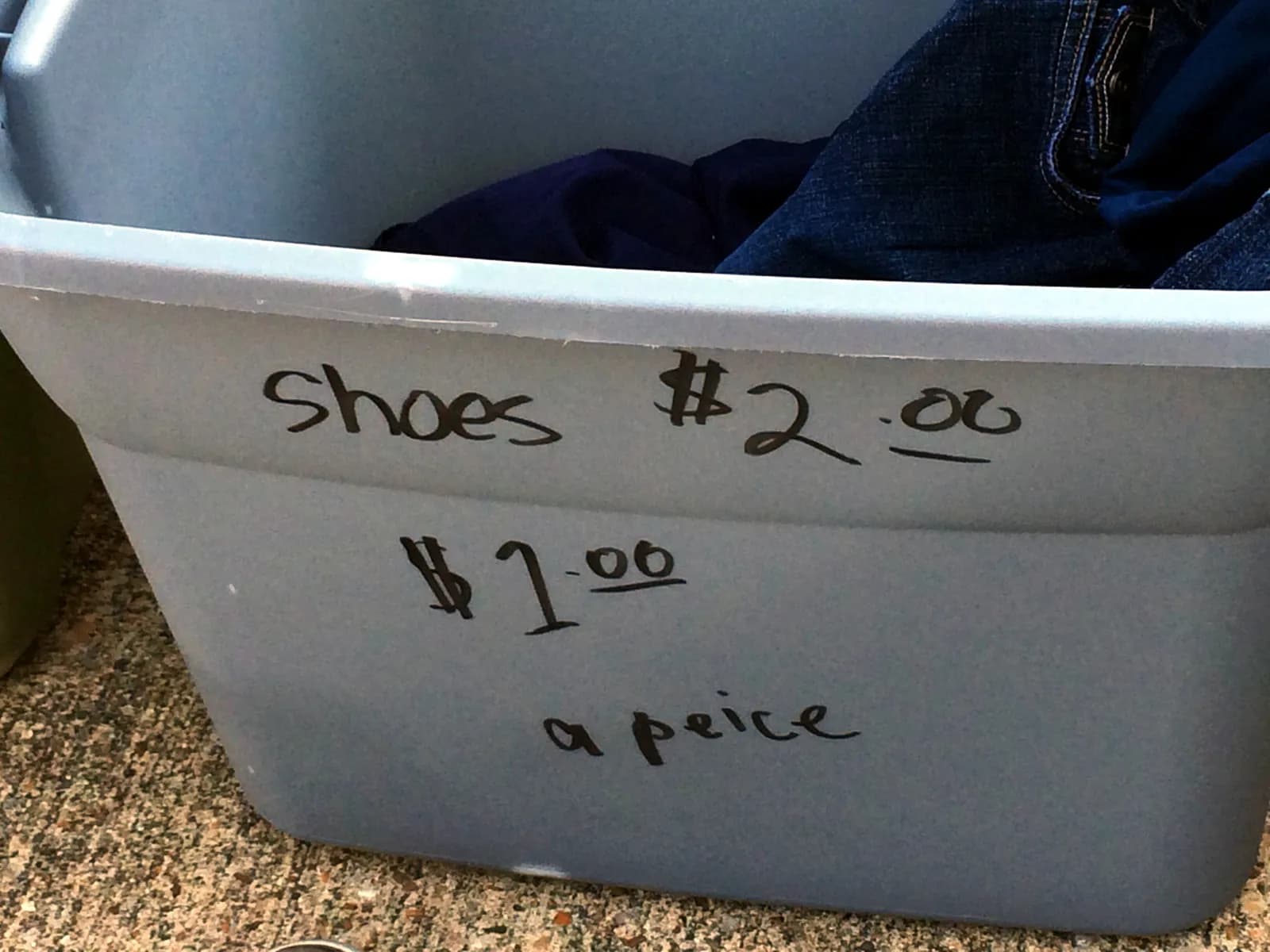
Price in quarters and whole dollars, so change is easy, and decide before you open whether you'll take less. Kentucky's guide notes that sellers are less likely to come down early in the day; New Mexico's suggests sticking to your prices for the first two hours or so, then coming down as it gets quiet.
Price for what you'll do with the leftovers
Decide before the sale what happens to everything that doesn't sell, because it changes your prices. If you're going to put the rest on the curb with a “free” sign and post it on your local Buy Nothing group, or book a donation pickup for the afternoon, then anything that sells for a dollar beats doing that: price everything low from the start and cut it again at noon. If you don't mind keeping what's left for another sale, you can start higher.
Charities don't take everything: The Salvation Army's stores won't take broken or dirty appliances, gas appliances, large old TVs or paint (its list), so plan for those separately.
What you can't sell
Federal safety law applies to yard sales: the Consumer Product Safety Commission's guide for resellers says its rules cover “individuals holding yard sales and flea markets”, and that “it is illegal to sell any recalled product” ( CPSC Resellers Guide, 2025). Giving them away isn't allowed either. Don't sell or give away:
- anything that's been recalled (search cpsc.gov/Recalls by name);
- drop-side cribs, and most cribs made before June 2011;
- inclined infant sleepers, like the recalled Fisher-Price Rock ’n Play;
- baby gear that's broken, wobbly or missing parts, even if it hasn't been recalled;
- children's metal jewelry over the federal lead limit;
- infant car seat carriers that are recalled or past the date on the label.
The guide's own advice for anything in doubt: “When in doubt, throw it out!” Craigslist, Facebook and OfferUp ban recalled items too, so they can't go online either.
Questions
- How do you price items for a garage sale?
- About 30% of the new price for lightly used things, 10% for well used and up to 50% for unused, below what they sell for online, with a price on everything.
- How should I price clothes at a garage sale?
- Simplest is one price per kind: $1–3 for adult tops and jeans, 50¢–$1 for kids' clothes, more for coats and anything new with tags.
- How much should I charge for books and DVDs?
- A dollar or two each, or a box price. Thrift valuation guides put a paperback at $1–2.
- Is there an app for pricing garage sale items?
- Our What is it worth? check works from a photo in your phone's browser, with no app to install. eBay's sold listings are the other quick check.
- What sells best at garage sales?
- Furniture, tools, kids' clothes and toys, bikes, and kitchen things, especially brands people collect.
- What are the biggest pricing mistakes?
- Pricing at what you paid or at online prices, leaving things unpriced, and refusing reasonable offers in the last hour.
- How do I sell everything at a garage sale?
- Price low from the start, cut prices in the afternoon (half price, or a dollar a bag), and book a donation pickup for what's left.
- Do I pay tax on garage sale money?
- Usually not: in California, no seller's permit is needed for up to two garage sales in 12 months, and things sold for less than you paid aren't taxable income (rules and tax).
How much change to bring, and the rest of the day: how to have a successful yard sale.
Post your garage sale
Once it's priced, post it free on Estate Sale Zone: your sale goes on the map and into the Thursday email of the weekend's sales, with signs to print and pictures to share.