Thrift store finds to look for: the marks that tell you what you’ve found
By Rory at Estate Sale Zone · Published
Turn things over. At a thrift store, estate sale or garage sale, the finds to look for are the ones whose marks you recognise: a maker's mark pressed into the bottom of glass, a backstamp on china, a name on cast iron, a signature on the back of costume jewelry. Below are 76 of them, each with a drawing of what to look for and what it tells you.
A mark tells you who made a piece and, often, roughly when. It doesn't tell you what that piece is worth: condition, rarity and demand decide that. Once you know the maker or pattern, look up what the same thing has sold for, or use our free What is it worth? photo check. Each mark below links to its full page on What Does This Symbol Mean, a reference site we also run, with more about the mark and the sources for it.
Where to look for marks
On glass and china, look at the middle of the base. On cast iron, look at the bottom of the pan. On jewelry, look at the back, the clasp and any small plaque; the stamps are tiny, so a jeweler's loupe helps. On books, look at the copyright page and the back board. Clothing and textiles have a number on the care label.
A small UV flashlight is worth carrying for glass. Uranium glass glows green under it, and ORAU's Museum of Radiation and Radioactivity calls a black light in the dark perhaps the most reliable way to find uranium in glass (ORAU).
Kinds of glass to look for
These are kinds of glass, not one maker’s mark, so most pieces carry no stamp at all. You tell them by color and by how the glass behaves: uranium glass glows green under a black light.

Uranium glass
Glass colored with a little uranium, usually yellow or yellow-green, that glows bright green under a black light. It is slightly radioactive.

Vaseline glass
Clear yellow to yellow-green uranium glass, named by collectors for looking like petroleum jelly. It glows green under a black light too.

Milk glass
Opaque glass, usually white, first made as a cheaper stand-in for porcelain. Blue, green and black milk glass exists as well.

Carnival glass
Pressed glass with a metallic, rainbow sheen. Fenton made it first, in 1907; collectors gave it the name carnival glass decades later.

Depression glass
Cheap, machine-pressed colored glass made in the US from the late 1920s into the 1940s, often given away as a premium. Pink and green are the colors people know.

Jadeite glass
Opaque pale green glass made into kitchenware and dinnerware by McKee, Jeannette and Anchor Hocking’s Fire-King line, from 1930 into the 1970s.

Custard glass
Opaque pale yellow glass, colored with uranium, made in the US from the 1890s and often painted with flowers or a souvenir town name.
More: Glassware types and makers’ marks on What Does This Symbol Mean.
Makers’ marks on the bottom of glass
American glassmakers pressed these into the glass itself, usually in the middle of the base. Hold the piece up to the light and tilt it: a pressed mark is easy to miss on clear glass.
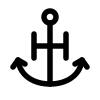
Anchor Hocking
An anchor with a capital H across it, pressed into Anchor Hocking glass from 1938. The company still makes glass in Lancaster, Ohio.
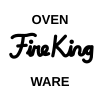
Fire-King
Anchor Hocking’s name for heat-proof ovenware, and later dinnerware, from 1942. The mark is most often a script Fire King between Oven and Ware.
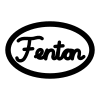
Fenton
Fenton in script inside an oval, pressed into Fenton Art Glass from 1970. From 1980 a small number beside it gives the decade.
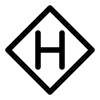
Heisey (H in a diamond)
A capital H in a diamond, pressed into A. H. Heisey & Co. glass from about 1900 until the factory closed in 1957.
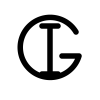
Imperial (IG)
An I laid over a G, Imperial Glass’s mark from 1951. An added L means 1977 or later, after Lenox bought it, and an A means 1981 to 1984.

Westmoreland (WG)
A W and G intertwined, on Westmoreland Glass from the late 1940s until the factory closed at the start of 1984.

Federal (F in a shield)
An F in a shield, the Federal Glass Company’s mark from 1932 on tumblers, tableware and kitchen glass. Federal stopped making glass in 1979.
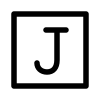
Jeannette
A J in a square, registered in 1941, on a small share of Jeannette Glass pieces. Most Jeannette glass is unmarked.
More: Glassware types and makers’ marks on What Does This Symbol Mean.
Pyrex and Depression glass patterns
Vintage Pyrex bowls and casseroles are known by their printed pattern, and Depression glass by its pressed one. The pattern name, with the dates it was made, is what to search for when you look up a piece.
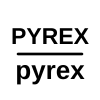
PYREX vs pyrex
Two styles of the same brand name. The Corning Museum of Glass dates the switch to lower case to the late 1970s, and says the lettering alone doesn’t tell you what glass a piece is.

Butterprint
A farm couple with wheat, roosters and corn, usually turquoise on white or white on turquoise, made from 1957 to 1968.
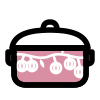
Gooseberry
Gooseberry branches with leaves and berries, mostly pink on white or white on pink, made from 1957 to 1966.

Pink Daisy
White daisies on a pink casserole, made from 1956 to 1962. With Snowflake, it was the first printed pattern on opal Pyrex.

Spring Blossom
Green and white flowers and dots, made from 1972 to 1981. Collectors often call it Crazy Daisy.

Butterfly Gold
Gold-brown butterflies and flowers on white, made from 1972 to 1981 to match the Corelle dinnerware of the same name.

Town and Country
Orange and brown eight-pointed stars in a Pennsylvania Dutch style, made from 1963 to 1967.

Snowflake
Two rows of snowflakes, most often white on turquoise, made from 1956 to 1967.

Cherry Blossom
Cherries and leaves on branches, pressed by Jeannette from 1930 to 1939, mostly in pink and green.

American Sweetheart
Swags and scrolls, made by MacBeth-Evans from 1930 to 1936, mostly in pink and a thin white glass called Monax.

Miss America
A Hocking Glass pattern from the mid-1930s, mostly pink or clear, with even rays pressed into the base of each piece.

Royal Lace
Hazel-Atlas, 1934 to 1941, in clear, green, pink and a deep cobalt blue the maker called Ritz Blue.
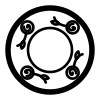
Mayfair (Open Rose)
Open roses on stems, made by Hocking Glass from 1931 to 1937. A different Federal Glass pattern of 1934 shared the name until Federal renamed it.
More: Pyrex and Depression glass patterns on What Does This Symbol Mean.
Pottery and porcelain marks
On china the mark is on the base: painted under the glaze, printed as a backstamp, or impressed in the clay. Several of the best-known words on a backstamp name a place or a kind of ware, not a maker.
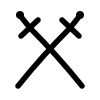
Meissen crossed swords
Two crossed swords painted in blue under the glaze, the mark of the Meissen porcelain factory in Saxony since the 1720s.
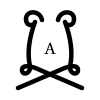
Sèvres (interlaced Ls)
Two script Ls back to back, the cipher of Louis XV and the mark of the French royal porcelain factory. A letter inside it gives the year a piece was made.
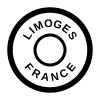
Limoges
A city in France where porcelain has been made since 1771, not one factory. Many makers printed Limoges on their wares.
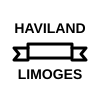
Haviland
The backstamps of the porcelain firms the Haviland family, New York china importers, ran in Limoges: Haviland & Co., and Théodore Haviland’s separate company from 1893.

Royal Copenhagen three waves
Three wavy blue lines for Denmark’s three waterways, Royal Copenhagen’s mark since 1775. The crown above them was added shortly before 1904.
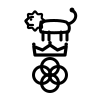
Royal Doulton lion and crown
A lion on a crown over Royal Doulton and four interlocking Ds, used by Doulton’s Burslem factory after it was granted a royal warrant in 1901.
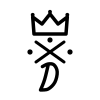
Royal Crown Derby
A crown over a dotted cross and a D is the old Derby mark, painted by hand from about 1780 into the 1830s. The firm called Royal Crown Derby dates from 1890.
Wedgwood
WEDGWOOD impressed in the clay in plain capitals. The words and code letters around it place a piece in a period of the factory’s history.
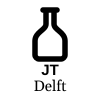
Delft
The Dutch town where Delftware was made from the early 1600s. On pieces since the late 1800s the word often names a blue-and-white style, not the place. Royal Delft marks its own with a bottle, JT and Delft.
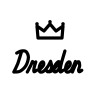
Dresden
The city where many studios decorated porcelain in the Meissen style in the 1800s. A crowned Dresden mark is not Meissen’s mark.
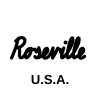
Roseville
Roseville Pottery of Ohio made art pottery from about 1900 until 1954. Raised script Roseville with U.S.A. and a shape number appears on lines from about 1937.
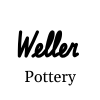
Weller
S. A. Weller of Zanesville, Ohio, 1872 to 1948. Impressed WELLER, often with an art line’s name, came first; a script Weller or Weller Pottery came later.

McCoy
Nelson McCoy Pottery put McCoy on its wares from about 1940 until it closed in 1990. Earlier pieces say NM or nothing.
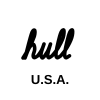
Hull
Hull Pottery of Crooksville, Ohio, 1905 to 1986. A script Hull dates from 1949 and a lower-case hull from the 1960s.
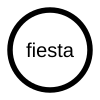
Fiesta
Lower-case fiesta is the mark of Homer Laughlin’s Fiesta dinnerware, made from 1936 to 1973 and again since 1986.
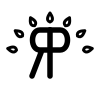
Rookwood flame mark
A reversed R and a P back to back, Rookwood Pottery’s monogram. One flame was added each year from 1887 to 1900, and a Roman numeral gives the year after that, so the mark dates the piece.
Ironstone
A hard, heavy earthenware patented in Staffordshire in 1813. On a backstamp the word names the kind of ware, used by many British and American potteries.
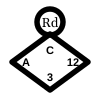
Registered design diamond
A diamond on British pottery, glass and metalwork showing the design was registered between 1842 and 1883. Its letters and numbers give the date of registration.
More: Pottery and porcelain marks on What Does This Symbol Mean.
Silver plate, pewter and cast iron marks
Most of the stamps on silver-colored flatware and serving pieces at a thrift store mean silver plate or no silver at all. Sterling is marked STERLING or 925. Cast iron pans carry the maker’s name on the bottom.

EPNS
Electroplated nickel silver: a copper, nickel and zinc base with a thin coat of silver. Not solid silver.
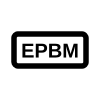
EP, EPBM and other electroplate marks
EP means electroplated, and the letters after it name the base metal, as in EPBM for Britannia metal. None of them means solid silver.
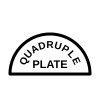
Quadruple plate
A grade name on nineteenth-century American silver plate. It was the maker’s own claim about the plating, not a legal standard.
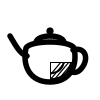
Sheffield plate
Copper with silver fused onto it, made from the 1740s until electroplating replaced it in the mid-1800s. It is not solid silver, and it doesn’t mean silver hallmarked in Sheffield.
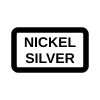
Nickel silver (German silver)
An alloy of copper, nickel and zinc that looks like silver and contains none. It’s the usual base under silver plate.

Pewter touchmarks
A pewterer’s own mark, often with a name or initials. Other stamps on old pewter, like a crowned rose or an X, were claims about quality.

Griswold
A cross in a double circle with GRISWOLD across it, on cast-iron and aluminum cookware from Erie, Pennsylvania. Earlier pieces were marked ERIE.
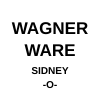
Wagner Ware
Cast-iron and aluminum cookware made in Sidney, Ohio, from 1891, marked Wagner with the town’s name.
More: Silver plate, pewter and cast iron marks on What Does This Symbol Mean.
Costume jewelry signatures and silver marks
Signed costume jewelry has the maker’s name stamped on the back, on the clasp or on a small plaque. A loupe helps: the stamps are tiny and often worn.
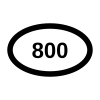
800 (continental silver)
80 percent silver, a European standard below sterling’s 925.
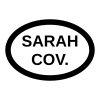
Sarah Coventry
SARAH COV. or SARAH COVENTRY: costume jewelry sold at home parties from the late 1940s to the early 1980s.

Miriam Haskell
A New York jewelry house from the 1920s. Haskell pieces weren’t signed until about 1947, so many genuine early ones carry no name.
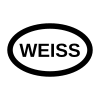
Weiss
Albert Weiss & Co. of New York, a costume jewelry firm from 1942 to 1971. Said “wice”.
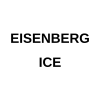
Eisenberg
EISENBERG ORIGINAL, EISENBERG ICE or a single E, from a Chicago dressmaker’s jewelry line. Eisenberg Original is the earliest, from about 1935.

Trifari
TRIFARI, often with a crown over the T. A © beside the name means 1955 or later.

Napier
The Napier Co. of Meriden, Connecticut, which took the name in 1922.

Monet
A costume jewelry line launched in 1937 by Monocraft of New York and Providence. Said “Mo-nay”.
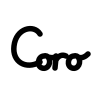
Coro
Coro, in script or block letters and often with a flying horse, founded in New York in 1901. Corocraft and Vendome were its other lines.
More: Jewelry marks on What Does This Symbol Mean.
First edition and book club marks
The marks on a book are on the copyright page, the back board and the edges of the pages.
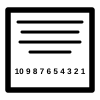
Number line (printer’s key)
The row of numbers on the copyright page counts printings. The lowest number left is usually the printing, so a line with a 1 in it marks a first printing.
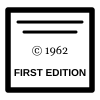
First edition statement
The words “First Edition” on the copyright page. Publishers use the phrase in different ways, so the words alone don’t settle which printing a copy is.

Book club edition marks
A small dent in the lower corner of the back board, a jacket with no price, or “Book Club Edition” on the flap: a book club copy, not a publisher’s first.

Remainder mark
A stroke of marker, a dot or a stamp on the page edges, most often the bottom: the publisher sold that copy off cheaply as unsold stock.
More: First edition and book club marks on What Does This Symbol Mean.
Country of origin marks that date a piece
A country name can date a piece, because some of these countries no longer exist and some marks were only used for a few years. Look on the base, on a label, or moulded into plastic.
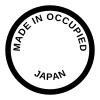
Made in Occupied Japan
Exported from Japan during the Allied occupation after the Second World War. Exports were ordered marked this way from February 1947.
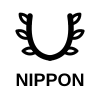
Nippon
The Japanese name for Japan, used as the country of origin on goods for the US market until 1921.
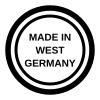
Made in West Germany
Made in the Federal Republic of Germany, a separate state from 1949 until reunification in 1990.
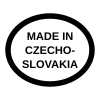
Made in Czechoslovakia
Made in Czechoslovakia, which existed from 1918 until it split into the Czech Republic and Slovakia at the end of 1992.
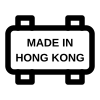
Made in Hong Kong
Made in Hong Kong. US Customs accepted Hong Kong as a country of origin until 2020; goods made there since must say China.
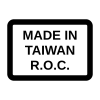
Made in Taiwan (ROC)
Made in Taiwan. R.O.C. is the Republic of China, the government that moved to Taiwan in 1949.
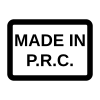
Made in PRC
Made in mainland China. PRC is the People’s Republic of China.
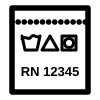
RN number
A number the US Federal Trade Commission gives a company that makes or sells clothing and textiles. Look it up to find the company behind a label.
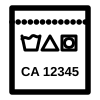
CA number
The Canadian version: CA and five digits, issued by the Competition Bureau in place of a company’s name on the label.
More: Country of origin marks on What Does This Symbol Mean.
What to look for at estate sales and garage sales
The same marks, in more places. An estate sale usually covers a whole house, so the kitchen cupboards, the china cabinet, the jewelry box and the bookshelves are all there to turn over. Garage sales are smaller and change every weekend.
Bring the UV flashlight and the loupe, and your phone to look up sold prices. To find sales, Estate Sale Zone lists estate, garage, yard and moving sales in San Diego, Los Angeles and Orange County on one map, each with its days, hours and address.
Questions
- Does a mark mean a piece is worth money?
- No. A mark names a maker or a kind of ware, and most marked pieces were made in large numbers. It tells you what to search for when you look up sold prices.
- What if a piece has no mark?
- Plenty of good pieces were never marked: most Depression glass, early Miriam Haskell jewelry and Fenton glass made before 1970, for example. The kind of glass, the pattern or the style can still tell you what it is.
- Is uranium glass safe to own?
- We don't give advice on that. The US Nuclear Regulatory Commission's assessment of it is in NUREG-1717, and the EPA has a page on radioactivity in antiques.
- Can you tell me if my piece is real?
- No. Neither this page nor What Does This Symbol Mean authenticates or values a piece. For that, ask an appraiser or a collectors' society for the maker; many are listed in the sources on each mark's page.
Find a sale to look through
See this weekend's estate, garage and yard sales on the map, and save the ones you want to visit.